
Knin - the Kings City

Posted by admin on okt 25th, 2008
2008
okt 25

KNIN - From FortressThe city of Knin is situated in the Dalmatian mainland, close to that source of the river Krka (Know from the National park Krka), do to it geographical position Knin is not a typical tourist, but for the Croatians the city is of great importance, mainly do to the following:


  • In the beginning of the second millennium, the city capital and seat of the Croatian kings – which also so explains why the city is referred to as that kings city or Zvonimirov grad.
  • During the Balkan war, the city was occupied by the Serbs and made capital of the republic of Serbia Krajina, the Croatian forces liberated the city under the Operation storm on the 5th of August 1995, the 5th of August has later been declared a national holiday – the Victory and Homeland Thanksgiving Day. And is celebrated each year with a 3 days event in Knin.


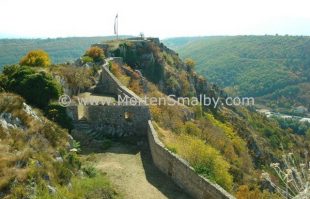
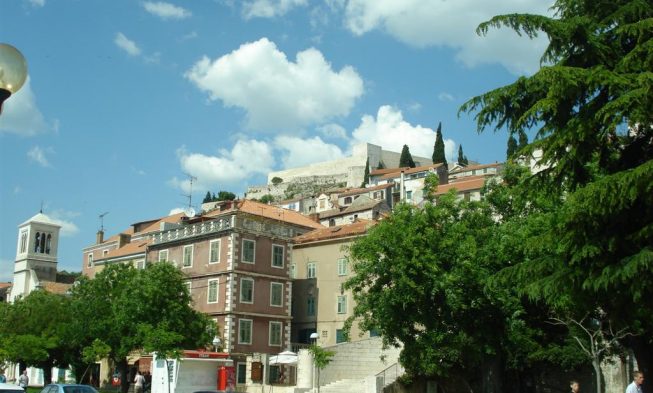
The city has one of the largest fortification in Dalmatia, (The largest I have seen down here), during the last decade large parts of it has been completely restored. For the entrance of 20 Kuna you can visit not only the fortress but also the museum inside the fortress. Be aware that there is limited parking available close to the entrance.


Knin_map_fortress Knin_fortress Knin_fortrees_1


How to find Knin:


Knin is found on the road D1 from Zagreb to Split, if you are coming from National park Plitvice as we did, you have a 2-2.5 hour to get to Knin.


Another option is to take train from Zagreb to Split.


Here you can see all our pictures from the fortress in knin


Feel free to add usefull information about Knin in the comments. - Thanks.

Dubrovnik – the Perl of the Adriatic see.

Posted by admin on okt 16th, 2008
2008
okt 16

One of our absolute favourite cities here in Croatia is Dubrovnik, we have visited the city numerous times, both privately as well as professionally, and every time we have had a great time in this historical pearl.


Historically Dubrovnik has always been very special, as the city was a republic it had a very interesting political system, the major / governor was elected for a period of only one month, this was done to avoid corruption and keep focus on working in the interest of the republic. – I am sure a few citizens around the world could benefit from a similar system in their country.Open-mouthed


DUBROVNIK  View from the Wall DUBROVNIK  Street Old town DUBROVNIK  Pile Gate

See more pictures from Dubrovnik here: Dubrovnik Pictures


Before the Balkan war Dubrovnik was the absolute top destination in Croatia, the war, where large parts of the old town was damaged, was of course a major set back for the city, but meanwhile the city has regained its position as one of the major tourist spots in Croatia. The old town of Dubrovnik has been completely rebuild, only visible evidence left from the Balkan war is the many new red roof tops in the old town.


When we go to Dubrovnik we normally take the coastal road from Split, which takes about 4 to 4.5 hours by car, the trips offers a magnificent view on the coast and the Dalmatian islands. If you follow the coastal road you will have to pass through Bosnia and Herzegovina about 60 km north of Dubrovnik, so please remember the following.


  • Passport
  • Not to bring any items, which are applicable to custom?
  • It is wise not to speed in Bosnia, as you most likely will meet the police with a “laser pistol” checking your speed.


Alternative to going by car (or bus) is taking the local ferry line, which goes from Split, via Hvar and Korcula to Dubrovnik; we tried this once and can absolutely recommend it, although the trip takes around 9 hours.


Here is a fee tips which might be useful for a trip to Dubrovnik:


  1. Parking


  • Parking in Dubrovnik is relative expensive (1.5-2 Euro/hour) there are 3 parking spaces close to the wall, but before you decide to park on one of those you might read below where to find the no charge parking space, just 500 meters from Pile Gate.


This is how you find the no charge parking space:


  • Follow the signs direction centre and later direction Hotel Hilton, when you pas Hilton on your right hand side, continue for about 150 meters, on your left hand you will see some green containers, here you have to turn left, follow the small road up hill and you are there (The best time to find a free space is early morning and late in the afternoon).


2. What to see or do while you are in Dubrovnik?


  • The e wall which is the absolute highlight.
  • The many churches inside the wall and the Cathedral.
  • Visit the city part Gruz where you find the green market and lots of small streets with the most beautiful private gardens in Dubrovnik, (In this part of town you also find the largest supermarket – Konzum).
  • Take a daytrip to National Park Mljet.
  • Drive to Mline and Cavtat which is south of Dubrovnik.
  • Rafting trip in Montenegro.


3. Prices and other useful stuff


  • Dubrovnik is much more expensive then e.g. Split, but still 20-30% cheaper then e.g. Copenhagen
  • The city beaches can be quite crowded, so get there early or go to the city part Babin Kuk instead.
  • In main season June – September, you should book accommodation before you arrive, otherwise you risk ending up far away from the city centre.
  • Ask your land lord for a pick up in the Airport, as it is quite expensive with a taxi.


Hope these few tips will be helpful on your trip, and I of course would be delighted of any feedback, which could be helpful for other travellers.


Here you can see a list of other interesting thinks we right about: Croatia Travel stories


And here you can see our 3000 pictures from Places we visited in Croatia: Pictures Croatia

NEW UNESCO WORLD HERRITAGE SITE IN CROATIA

Posted by admin on jul 11th, 2008
2008
jul 11

On the 8th of Juli Stari Grad Plain was added to UNESCO’s list of world cultural herritage


The Stari Grad Plain on the Adriatic island of Hvar is a cultural landscape that has remained practically intact since it was first colonized by Ionian Greeks from Paros in the 4th century BC. For 2400 years this area has been used for Wine and Olive growing, The landscape features ancient stone walls and trims, or small stone shelters, and bears testimony to the ancient geometrical system of land division used by the ancient Greeks.


With the adding of Stari Grad Plain, Croatia now holds 7 UNESCO sites:


6 of the Croatian UNESCO site is on the list for world Cultural herritage


  • Historic city of Trogir

  • Stari Grad Plain

.

The last site is on UNESCO list for world Natural herritage


  • The Plitvice Lakes National Park


In addision to these 7 sites, Croatia has several sites on the Tentative list


Here you find all our favorit links from Croatian - Links about Croatia


Traveling to Croatia

www.solitum.hr

SPLIT: A thousand Years of Literacy

Posted by Aneta on apr 23rd, 2008
2008
apr 23

From 21.-28 April 2008 in Split, Croatia, start days of Festival of Croatian drama and authors’ theatre and scientific, literary and publishing program.


Culture manifestation has international character dedicated to Croatian drama words and act of Marko Marulic.


marulic  judita_


Days of Marulic, has been establishing in 1991 and from that year has been holding every year in April. At memorial date when Marulic finish writing his epic poem Judita.


Marulic "father of Croatian literature was born in 1450, after Split had been for thirty years under Venetian rule. His early life appears to have been sober and godly, although not entirely lacking in worldly pursuits. He had a number of excellent Paduan teachers in Split, and probably followed the customary path of young Dalmatians to study in Padua himself. All his life he lived the full life of a patrician of his time: above all involved in the group of writers; managing his estate; working as a lawyer and judge. He also took an interest in archeology and there is evidence that he painted, illustrating his epic poem, Judita, himself.


One of Marulic`s own illustrations from his epic poem JUDITA


JUDITAmarulic_


By the second half of the fifteenth century Split had developed into a lively literary centre with a wide circle of ecclesiastics and educated men from secular professions writing prose and verse in both Latin and Croatian. At the centre of this circle was Marko Marulic: one of the outstanding figures of early Croatian literature. He gained an international reputation with his Latin works, which were widely read for many years, and he set what proved for a long time to be an unattainably high standard for vernacular literature. He was also involved in various aspects of public life, from which he emerges as an exceptionally dignified, responsible human being.


He was the most famous spiritual writer of his time in Europe, and also the first who defined and used the notion of psychology, which is today in current use.This year program can you find at: www.hnk-split.hr


Here you find all our favorit links from Croatian - Links about Croatia

Traveling to Croatia!
www.solitum.hr

Authentic gift ideas from Croatia part 2

Posted by Aneta on mar 27th, 2008
2008
mar 27

- Pillow gifts – original Croatian hand made “licitar” hearts

- Pillow gifts – original Croatian hand made silk products

- Pillow gifts – embroideries from


Konavle valley

licitars heart licitars  Croat's warm heart T-shirt

licitari2 licitars1


Croat’s heart T-shirt are 120 kuna and harts are around 30-40 kuna.


gourds


- Pillow gifts – famous “Paska Cipka”, lace works from the Pag island. The most vivid centre, where the tradition successfully survived until the present time is the Pag island.


Here you find all our favorit links from Croatian - Links about Croatia

.

Traveling to Croatia!
www.solitum.hr

Authentic gift ideas from Croatia part 1

Posted by admin on mar 25th, 2008
2008
mar 25

How often do you spend hours in foreign country searching for right present for your family, girl or boy friend, friends, your chief? If you are for a moment in Croatia or you have plans to visit Croatia I will suggest you some traditional gift ideas from Croatia.


- Ball point pen – PENKALA, used by almost everyone, almost everyday, almost everywhere. It was invented here by Slavoljub Eduard Penkala 1871 - 1922. “Penkala” is a famous Zagreb souvenir.


pencil pen

- The original “Croata” tie- a neck tie was first worn by Croatian horsemen who fought on the European fronts from the 17th century to the French revolution, when the French adopted this fashion and gave it name “cravate” (meaning “Croat”).


clip_image003 clip_image004 clip_image005clip_image006


- Croatian naïve Art Paintings-village life, celebrations, festivals, landscapes, portraits.


clip_image007clip_image008clip_image009


- Zvonimir Mihanovic paintings. Paintings for the world elite. Definitely the most valued Croatian painter in the US and many other countries.


clip_image013 clip_image014 clip_image015 clip_image016

Here you find all our favorit links from Croatian - Links about Croatia

.

Next »